


India Panics, Further Tightens Gold Flows As Rupee Collapses
Well, that escalated quickly…
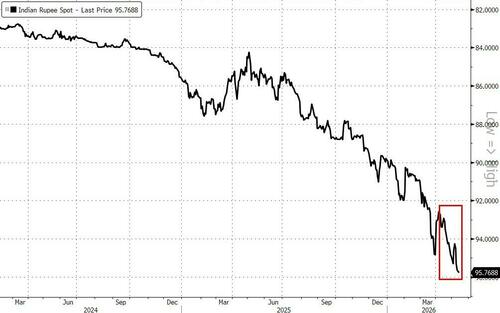
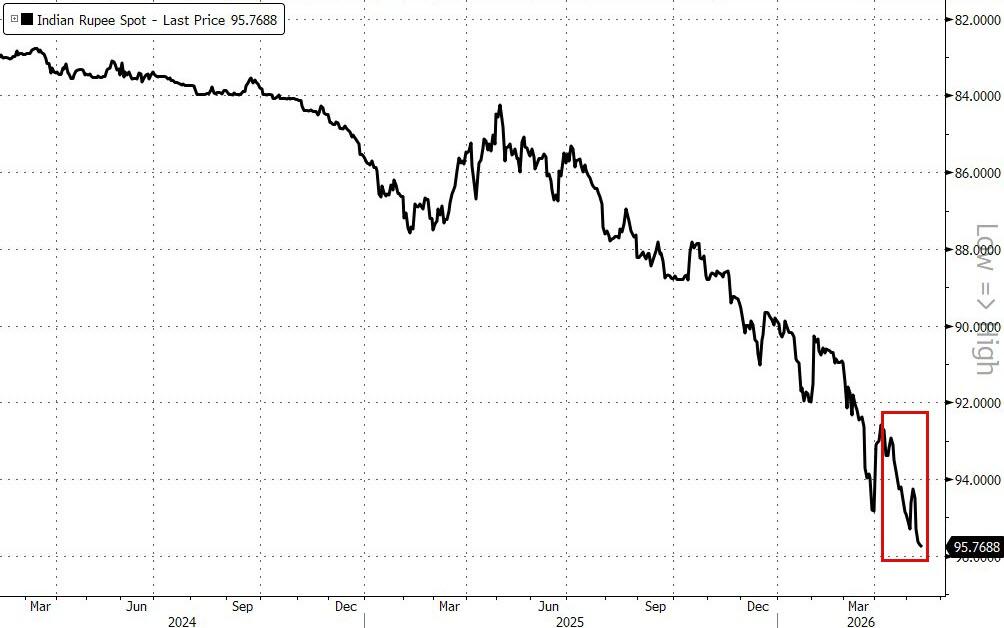
With the Rupee accelerating its declines to ever lower record lows against the dollar, Indian authorities have stepped up capital controls, focusing on curbing demand in the gold ‘exit’ route.
4 days ago, there were no signs of import duty hikes as Prime Minister Narendra Modi issued a rare weekend appeal urging citizens to forgo gold purchases as well as unnecessary foreign travel in order to help hold up the currency..
2 days ago, tariffs were more than doubled on gold and silver imports to 15% and 6% respectively.
And today, they are doing even more with India now tightening the advance authorisation route, effectively capping how much gold individual exporters can bring in through that channel.
A government notification stated that imports of bullion exceeding 100 kilograms would be subject to prior authorization, adding that any subsequent imports would only be granted after exports equivalent to 50% had been carried out.
The notification also introduced stricter checks for first-time applicants seeking permission to import gold under the scheme.
The government has also linked future import approvals to export performance.

India, the world’s third-largest oil importer, has been hit hard by the inflationary shock caused by energy disruptions in the Persian Gulf.
Higher import bills have driven sharp foreign-exchange outflows, pushing the rupee down to a record low and prompting the Reserve Bank of India to step in and sell dollars.
And the fact that gold is the country’s largest import item after crude oil does not help, which is why India is doing everything in its power to limit capital outflows.
As UBS explains, the new curbs don’t directly restrict the importing banks, but it does limit how much metal each participant can access, reducing the ability to build larger positions and tightening flows through the system.
The broader backdrop is that India is no longer purely a jewellery-led market.
Demand has become more investment‑driven, with a growing share of imports moving into financial holdings, including ETFs.
A significant part of last year’s import surge appears to have gone into investment rather than fabrication, which changes how the market behaves. During the initial phase of the recent Middle East escalation, Indian ETFs were among the first to react, selling roughly ~20 tonnes in the opening week of the move.
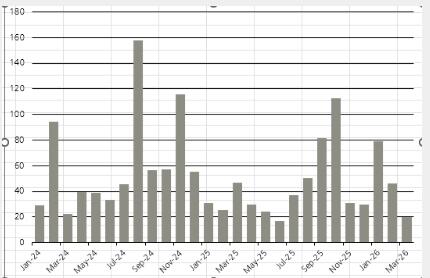
More immediately, demand has already been soft in recent weeks, as reflected in recent import data.
Monthly India Gold Imports below in tonnes, source: UBS
Near‑term uncertainty around fertiliser (urea) supplies also poses a risk to this year’s crop cycle, with the key monsoon period running into August, which could weigh on rural incomes and, by extension, gold buying.
The recent moves underscore policy concerns around curbing import-led dollar outflows from high foreign exchange-draining sectors, Madhavi Arora, economist at Emkay Global Financial Services said.
“We expect gold imports to fall by around 20-25% this year due to these steps.”
New Delhi is weighing several further emergency steps to shore up foreign-exchange reserves and limit the damage from the war in the Middle East.
If demand does recover, however, as seen in previous tightening cycles, attempts by the government to limit capital outflows via precious metals will only encourage activity to re‑route via unofficial channels (with smuggling picking up when the onshore market is constrained), to preserve purchasing power, and it is only a matter of time before India joins the rest of the financially suppressed developing world in actively pursuing such non-fiat alternatives as tether and bitcoin if the traditional gold and silver pathways are limited.
Tyler Durden
Thu, 05/14/2026 – 15:40Read More
Share This Article
Choose Your Platform: Facebook Twitter Linkedin